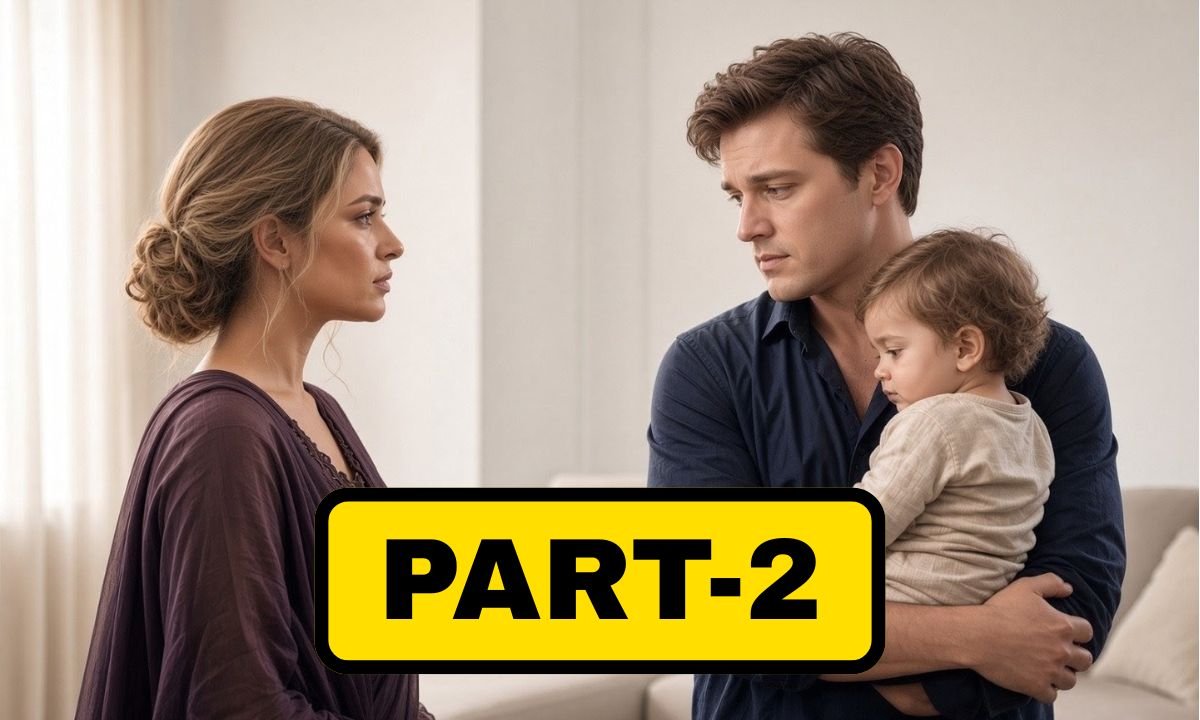
The divorce conversation changed everything. Until that moment, my husband had acted as though I would always be there. He believed I would cry.
I would get angry.
I would threaten to leave.
And eventually, I would forgive him.
Because that was what I had done before.
But this time was different.
I wasn’t threatening him.
I was leaving.
And he could feel the difference.
Over the next few days, his behavior changed completely.
He started calling constantly.
He sent long messages explaining himself.
He told me that the relationship with his mistress had become complicated.
He claimed he had been emotionally confused.
He said the adoption had happened because he felt responsible for the child.
I listened.
But every explanation led me back to the same question.
Where was that sense of responsibility when it came to our baby?
One evening, he came to the house and stood outside the bedroom door.
“I want to fix this,” he said.
I looked at him.
“You can’t fix everything.”
“I can try.”
“You already tried.”
“No, I didn’t.”
His voice cracked.
“I thought I was doing what was right.”
“For whom?”
He didn’t answer.
I knew.
He had been doing what was right for himself.
He wanted to be the hero in one story while destroying another.
He wanted to believe that adopting his mistress’s child made him responsible.
But responsibility wasn’t about choosing the easiest version of fatherhood.
It was about standing beside the people who depended on you.
And our baby depended on both of us.
He sat down on the edge of the bed.
“I’m sorry.”
I believed that he was sorry.
But forgiveness and reconciliation were two different things.
“I don’t hate you,” I told him.
He looked surprised.
“I actually wish I could hate you. It would make this easier.”
He lowered his head.
“But I don’t hate you. I’m just finished.”
That sentence hurt me too.
Because being finished with someone you once loved isn’t freedom at first.
It’s grief.
You grieve the person you thought they were.
You grieve the plans you made.
You grieve the version of your future that will never happen.
And then, slowly, you begin creating a new future.
My husband didn’t accept the divorce easily.
He called my family.
He asked them to convince me to reconsider.
He promised counseling.
He promised to end every connection with his mistress.
He even said he would reconsider the adoption.
But that last statement made me realize something.
He was still thinking of everything as a choice.
Something he could change whenever the consequences became uncomfortable.
He hadn’t understood that some decisions permanently change people.
The trust was gone.
The marriage was gone.
And I wasn’t willing to rebuild a house on a foundation that had already collapsed.
A few weeks later, we met with the lawyers.
For the first time, everything felt strangely calm.
There were documents.
Questions.
Dates.
Signatures.
It was almost surreal.
The man I had once promised to spend my entire life with was sitting across a table discussing the legal ending of our marriage.
He looked at me.
“You really don’t love me anymore?”
I took a breath.
“I loved you enough to give you every chance.”
He looked down.
“But you used every chance to choose someone else.”
He didn’t argue.
Because there was nothing left to argue about.
The divorce process wasn’t easy.
There were disagreements about money, property, and future responsibilities.
But one thing became clear to me.
I didn’t need revenge.
I didn’t need to destroy him.
I didn’t need to expose every detail of what happened.
I simply needed to walk away with my dignity.
The day the divorce was finalized, I sat in my car for several minutes afterward.
I expected to feel victorious.
Instead, I felt empty.
Then I placed my hand on my stomach.
And I smiled.
Not because everything was perfect.
It wasn’t.
But because I finally understood that my life had not ended with my marriage.
It had only changed direction.
I drove home and began preparing the nursery.
It was a small room.
Nothing extravagant.
A simple crib.
A soft blanket.
A few tiny clothes.
I stood in the doorway and imagined the life waiting for me.
There would be difficult nights.
There would be moments when I felt alone.
There would be questions I couldn’t answer immediately.
But there would also be laughter.
First steps.
First words.
First birthdays.
A lifetime of memories.
And I realized something important.
My child would never need to know every ugly detail of how their story began.
One day, when they were old enough, I would tell them the truth.
But I would never make them carry the weight of their father’s choices.
That burden belonged to him.
Not to our child.
Months later, my former husband contacted me again.
He said he regretted everything.
He said he had lost the woman he loved because of his own selfishness.
He said he wished he could go back.
I read the message several times.
Then I deleted it.
Not because I was angry.
Because I had finally stopped waiting for him to become the man I needed.
He had made his choices.
And I had made mine.
My divorce wasn’t the ending I had once imagined.
But it became the beginning I desperately needed.
I learned that sometimes the strongest answer isn’t a scream.
It isn’t revenge.
It isn’t proving someone wrong.
Sometimes the strongest answer is simply walking away.
When my husband told me to abort our baby, he thought he was ending a problem.
Instead, he ended our marriage.
And when he finally realized what he had lost, I had already learned something he never expected.
I could build a beautiful life without him.
And this time, I wasn’t going to ask anyone for permission to live it.